- 6 Posts
- 23 Comments


My favorite is the ending:
The Catholic Church is more than 2,000 years old. Declaring war on it is hardly civilized or politically smart. Trump has three years left in office. The Catholic Church will survive condemnation by those in power; it’s hardly the first time this has occurred in its long and storied history.
Also good:
Clergy members from various denominations have come to detention centers only to be turned away or arrested, wrestled to the ground or sprayed with pepper balls.
The Coalition for Spiritual and Public Leadership is suing the Trump administration for denying Catholic priests and ministers admission to its ICE facilities. The coalition’s executive director said, “For Catholics, pastoral care isn’t optional. We believe that it’s a lifeline.”
The response from Trump loyalists is to declare war on the Catholic Church.
“Boarder czar” Tom Homan condemned the bishops’ letter and the church as “wrong.”“I’m saying it as not only border czar, I’ll say it as a Catholic. I think they need to spend time fixing the Catholic Church, in my opinion.”
Thou doth protest to much Tom.


 2·1 month ago
roughly twelve miles south of the U.S.-Mexico border.
How da fuk do you miss the border by 12 miles? The territorial maritime distance is 12 miles… Next they’ll try the EEZ at 200 and call it an annexation.
Any tldr for those of us who aren’t YouTube watchers?
 38·2 months ago
Senate Majority Leader John Thune (R-S.D.) made the stakes clear Monday morning. There is only one “objector” to speeding up Senate consideration of the government funding package — Paul. The senator wants to strip a section from the bill that would prevent the sale of hemp-derived products like Delta-8 at gas stations, corner stores, or online without federal regulation.
Paul defended his stance as part of his duty to Kentucky. “Just to be clear: I am not delaying this bill. The timing is already fixed under Senate procedure. But there is extraneous language in this package that has nothing to do with reopening the government and would harm Kentucky’s hemp farmers and small businesses,” he said in a statement posted on X. “Standing up for Kentucky jobs is part of my job,” he added.
 47·2 months ago
I posted this as a perspective on AI that is not given by AI, nor by someone who believes it will stay this way, but nor am I promoting it. I believe it’s more nuanced that just being crap, although it is taking over many things in life. I have used it, I know how to use it for good (keeping it private, local, and to help teach reasoning as well as do the thing that we need done (like dishes, bills, and other bullshit). I’m fully aware it’s a bubble (14 billion to 1.4 trillion for OpenAI alone), dislike it and hate the energy waste. You all just seem to want to keep up the ignorant web user stereotype.
Have fun down voting something you don’t really understand.
Having done my research, and tried it, I’m not an ignorant F*** as I read and engage at least. You just like being a troll.
I think your sentiment and the back end requirements of AI is a big downfall of it, as while your sentiment has validity in many public facing deployments of it there are some things it is actually succeeding at. I speak from experience having used it for several specific use cases which it excels at, but you and others probably don’t have time nor care that this is true. And again marketing idiots out weight the deliberate approach that engineers and others might want, much less the economy might need.
The U.S. military has carried out 17 known attacks on boats in the Caribbean and Eastern Pacific Ocean since September, killing at least 70 people. The most recent attack, on a vessel in the Caribbean Sea on Thursday killed three civilians. Military officials admitted to lawmakers that they do not know the identities of all the people on board a vessel before they conduct a lethal strike. Following most of the attacks, War Secretary Pete Hegseth or President Donald Trump have claimed that the victims belonged to an unspecified designated terrorist organization, or DTO.
“This is not just a secret war, but a secret unauthorized war. Or, in reality, a make-believe war, because most of these groups we probably couldn’t even be in a war with.”
Experts in the laws of war and members of Congress say the strikes are illegal extrajudicial killings because the military is not permitted to deliberately target civilians — even suspected criminals — who do not pose an imminent threat of violence. The summary executions are a significant departure from standard practice in the long-running U.S. war on drugs, in which law enforcement arrested suspected drug smugglers.
…
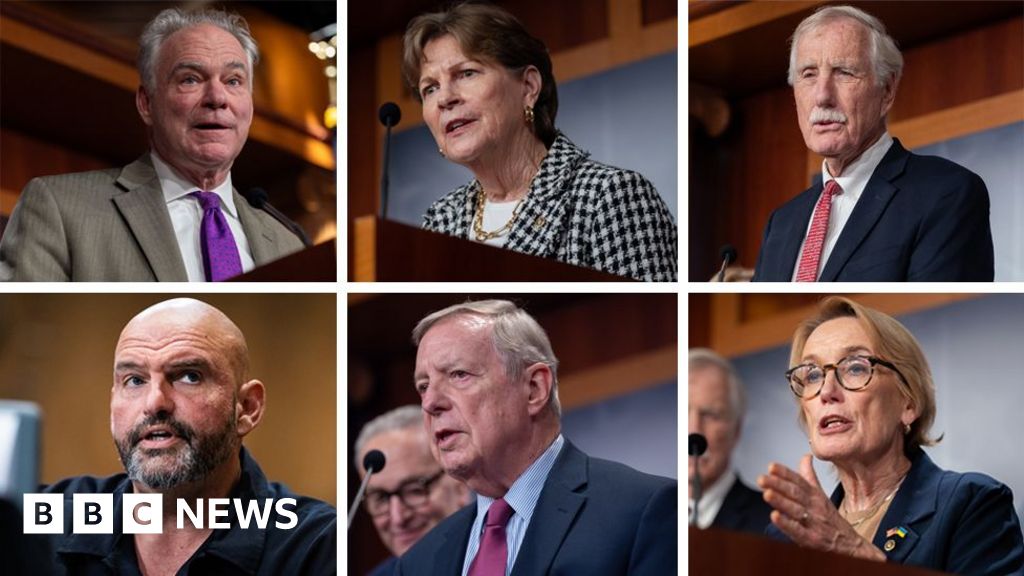
Senate Republicans blocked a war powers resolution on Thursday aimed at preventing Trump from attacking Venezuela after a bipartisan group of senators warned that the undeclared war on alleged drug smugglers in the region could escalate. The vote to advance the resolution failed with 49 senators supporting it and 51 opposing it.
The resolution, led by Sen. Tim Kaine, D-Va., would have directed the president “to terminate the use of United States Armed Forces for hostilities within or against Venezuela, unless explicitly authorized by a declaration of war or specific authorization for use of military force.” The resolution had 15 co-sponsors, including Sen. Rand Paul, R-Ky.
 2·2 months ago
Glad that helped the decision.
As someone who does this for privacy, I just end up using a password database to make notes on each provider. It holds the relevant authentication, payment, address, etc data in the notes. I religiously update it when I create something new or have to change. Categories make tracking easier, I.e. payment method = category, same for addresses, etc.
Interesting personal challenge.
Not sure if these quite meet what you need, but the might help you find where you are going.
Can I ask, what’s the problem you are solving in doing this? Might help understanding what you need.
@OP Is this what you mean? (I don’t have the time to jump into a 1:38:00 lecture, so I cheated and ask qwen for some help.)
At the 1:34 mark of Michael Parenti’s 1991 talk in Long Beach, California, he outlines strategies for achieving political and social change relevant to modern protest movements. Parenti stresses supporting progressive Democrats (e.g., Ron Dellum, Barbara Boxer, Tom Harkin) when they align with movement goals, arguing against running third-party candidates in races where progressive Democrats already represent critical voices against militarism and for marginalized communities. He advocates combining institutional engagement with grassroots tactics, including mass demonstrations, labor organizing, peace activism, and solidarity with global justice movements. This dual approach—working within existing political structures while maintaining independent mobilization—provides a framework for sustaining pressure toward systemic reform, resonating with current U.S. protest efforts seeking tangible policy shifts.


The Jubilee episode pitted British-American journalist Mehdi Hasan, renowned for his incisive debating style, against 20 self-proclaimed far-right conservatives, including Estelle. The discussion tackled divisive issues such as U.S. immigration policies, President Donald Trump’s leadership, the role of the U.S. Constitution, and the Israeli-Palestinian conflict. Estelle, using his online persona “Pinesap,” emerged as a lightning rod when he unapologetically embraced fascist ideologies during a tense exchange with Hasan.
…
Estelle further advocated for autocracy over democracy, arguing that the U.S. Constitution should be amended or ignored when it “fails to serve us.” When challenged on whether Democrats could similarly disregard the Constitution, he replied, “Absolutely not,” exposing inconsistencies in his stance. His comments, coupled with his refusal to unequivocally condemn antisemitism, fueled widespread condemnation online, particularly among NRI communities who viewed his rhetoric as a betrayal of shared values.
In the wake of the episode, Estelle announced on X, under the handle @FeelsGuy2003, that he had been fired from his role at VeUP Ltd, a tech firm with operations in the U.S., UK, Europe, and the Middle East. Claiming his termination was due to “political discrimination,” he launched a GiveSendGo fundraiser to support himself, alleging financial hardship. However, investigations by online sleuths have cast doubt on his narrative. A Threads post alleged that Estelle’s employment history was fabricated, with no verifiable evidence of his role at VeUP Ltd. The post further linked him to white nationalist Nick Fuentes’ network since 2022 and a fringe group dubbed the “Remilia cult,” purportedly connected to Elon Musk under the alias “Timeless Martian.” These unverified claims have intensified scrutiny of Estelle’s motives
Web use is hard to measure, but by one estimate monthly traffic from search engines has fallen by 15% in the past year. Some of the loudest complaints have come from the news media, an industry in which we acknowledge an interest. But the drought is a wider problem. Science and education sites have lost a tenth of their visitors in the past year. Reference sites are down by 15% and health sites by 31%. Some big names are being gutted: Tripadvisor.com, which recommends the best hotels or beaches, is down by a third; Webmd, which offers reassurance (or alarm) to the poorly, has fallen by half.
…
As the old model buckles, the web is changing. It is becoming less open, as formerly ad-funded content is hidden from bots, behind paywalls. Content firms are reaching people through channels other than search, from email newsletters to social media and in-person events. They are pushing into audio and video, which are harder for ai to summarise than text. Big brands are striking content-licensing deals with ai companies. Plenty of other transactions and lawsuits are going on. (The Economist Group has yet to license its work for ai training, but has agreed to let Google use select articles for one of its ai services.) Hundreds of millions of small sites—the internet’s collectively invaluable long tail—lack the clout to do this.
No one should expect the web of the future to look just as it does today. ai-powered search will rightly shake up some services: business directories, for instance, face disintermediation as answer-bots field queries such as “emergency plumber” or “houses for sale”. But the evaporation of incentives to create content presents a fundamental problem. If human traffic is drying up, the web will need a new currency
…
Bringing a new business model to the web is daunting; it may take a shove from regulators to get started. Yet everyone has an interest in making content-creation pay. Publishers may be the ones complaining now, but if the content tap dries up, ai companies will suffer, too. Some are more vulnerable than others. Whereas Meta can draw on data posted to its social networks and Google owns YouTube, the world’s biggest video vault, Openai relies entirely on others for its content.
If nothing changes, the risk is of a modern-day tragedy of the commons. The shared resource of the open web will be over-exploited, leading to its eventual exhaustion. If that process is not stopped, one of the great common properties of humanity could be gravely diminished. The tragedy of the web would be a tragedy for everyone.
As others have commented, the economist is presenting this as a capitalist issue that requires a monetary fix. The most ironic element to me is that one of the elements of the tragedy of the commons is that is indicates the requirement of a public interest and it’s regulatory interest so the commons can work. So another way to perceive this is that we need a non-capital framework to allow the web to persist. Say perhaps like roads are created as infrastructure to allow the free movement of it’s citizens in a “safe” and organized way, perhaps we should change our perspective on the utility of the we and it’s content. I’m not suggesting that we copy the transportation to the internet as it obviously breaks down, but the need to think outside the capitalist box is apparent. Libraries have been funded both publicly and privately as public interest, and have the capacity to work both for and nonprofit. This adaptation need not just be ‘free’ market driven. Especially as we do not actually live in a free market, but I’ll let others drive down that hole.

Has there been a discussions about how bad or skewed the titles are? I sympathize with the non-editorializing, but major news sources have become painfully bad at what they title. They are necessarily editorialized by their editors to the detriment of the readers.
I would suggest an allowance to at least indicate the editorializing title in the description.
For those who have read the Galaxy’s Edge series, I can only think of the appointees (aka 'Points). Political appointed officer who often end up getting the legionaries killed and lack the combat prowess/skill to be in the officer position they exercise.
Realistically we have many other direct commission officers such as the medical, engineers, legal, etc. What’s really different here is they are not requiring the full 5 week Direct commission officer basic course .
I first read this as plants, of the green leafy variety. Somehow I also think that is apropos of how little the Democratic caucus does. Congressional shrubs, who just sit there looking pretty.
USA voter registration including party affiliation are public record. https://protectdemocracy.org/work/why-is-voter-registration-data-public/
Building the sort of database you suggest is a very double edge sword though. Use of personal data to persecute people is a tool of fascist. Persuading people as it is currently used by candidates and their proxies is arguably part of democratic (the arguably part is that humans don’t make rational decisions due to cognitive biases, so it is not a fair choice if presented with manipulated information), but it is a way to distribute directed information in this modern age.
We need community and more engagement, not less and isolation. I empathize with the outrage response, but suggest it’s worth being careful in actions that take the form of the enemy.
Does anyone know of an indirect or mirrored source, just wondering if it will go down. Obviously the way back machine, but I’m not sure if it will pull the databased side of it.
Yea… Close…Not quite though. Basically, YOU HAVE TON FUCKING ACT YOU DIP SHITS! Do real things people can fucking believe in.
As it stand I still want both sides out of all the offices. When you actually represent me and the voters… Not some corporate lobby group, PAC, or persons with more money than sense but “We The People”, then I might vote for you.
Mamdani is a good start… If he follows through.